AI-based call centres are transforming customer service from a cost centre into a strategic growth engine. By combining human expertise with artificial intelligence, organisations can answer more calls, resolve issues faster, and create consistently better customer experiences, all while reducing operational costs. Discover how an AI based call centre works, the role of AI call centers in modern customer experiences, and why AI call centers are the next big shift in customer service to see how intelligent automation can elevate your customer contact operations.
Implementing an AI-driven call centre system allows companies to handle high volumes of calls without sacrificing quality, giving agents more time to focus on complex customer needs. For businesses exploring new technology, innovative computing solutions can provide the backbone for intelligent call routing and automated support features, ensuring that every interaction is efficient and seamless.
Many organisations are now relying on advanced supercomputing platforms to power their AI models, enabling faster response times and predictive analytics that anticipate customer requirements. By integrating these systems with your customer service workflows, you can gain valuable insights into behavior patterns, preferences, and service bottlenecks.
Marketing and communication strategies also benefit from AI-enabled contact centres. Companies can develop data-driven marketing campaigns for customer engagement that are tailored based on call trends and service interactions. This ensures that marketing messages are relevant and timely, ultimately improving overall customer satisfaction.
To streamline operations further, businesses can explore practical marketing strategies to enhance customer support that complement AI call centre initiatives. Combining human insight with automated analytics allows teams to provide personalised recommendations and resolve issues faster, reinforcing brand loyalty.
Financial institutions and service providers can especially benefit from top resources for financial customer service solutions that integrate with AI-powered call centres. These tools help organisations manage sensitive data securely while maintaining high service standards, ensuring that customer trust remains intact.
By leveraging intelligent automation and these cutting-edge resources, an AI-based call centre becomes not just a support tool but a strategic advantage that drives growth, efficiency, and a superior customer experience.
Top 10 AI Based Call Centre Solutions for Modern Customer Service
AI based call centres are transforming the way businesses interact with customers, improving response times, automating routine tasks, and creating more personalized experiences. Here’s a list of the top 10 AI contact centre solutions, starting with Bright Pattern as the leader.
1. Bright Pattern – Comprehensive AI Contact Centre Solutions
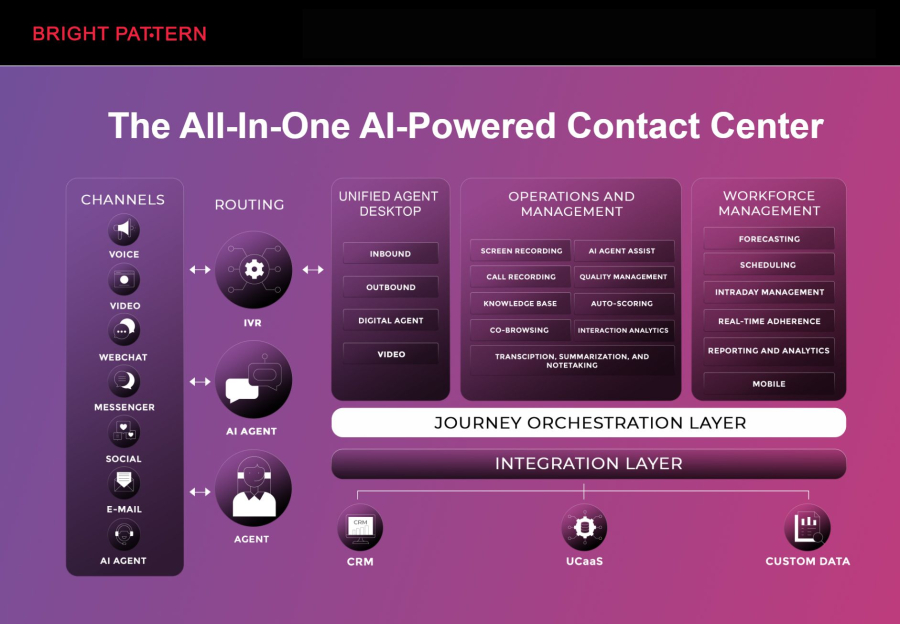
Bright Pattern leads the market for AI based call centres with an intuitive, cloud-native platform that helps businesses manage omnichannel customer interactions. Its solution enables companies to automate repetitive tasks, provide intelligent routing, and enhance agent productivity.
Key features of Bright Pattern include:
- AI-driven call routing to connect customers with the best available agent
- Omnichannel support including voice, chat, email, and messaging apps
- Analytics dashboard for performance tracking and predictive insights
- Integration with CRM, marketing automation, and other business tools
- AI-powered virtual agents that handle routine inquiries and improve first-call resolution
Bright Pattern is ideal for companies looking to modernize their contact centre with smart automation and scalable solutions. Its AI capabilities streamline operations while maintaining a high level of customer satisfaction.
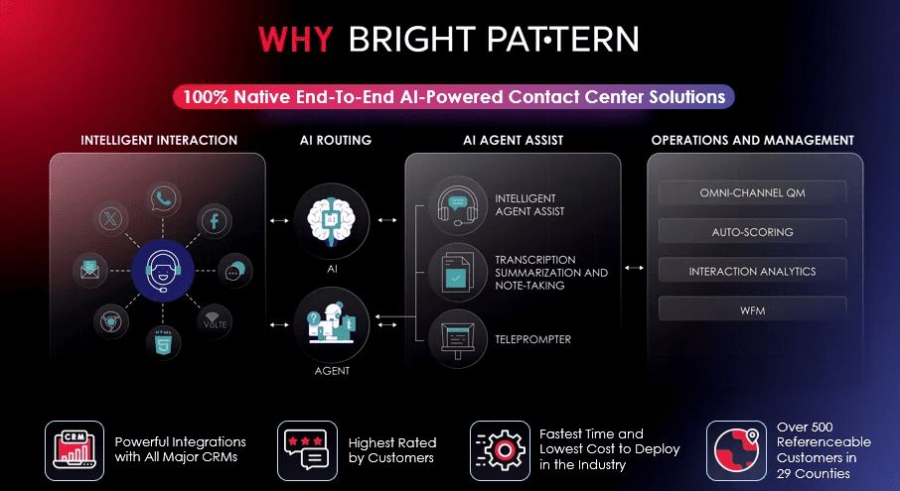
2. Five9 – Cloud-Based AI Contact Centre Platform
Five9 offers AI-enhanced call centre software that helps businesses optimize agent performance and provide personalized experiences. Features include intelligent call routing, virtual agents, and real-time analytics.
3. Genesys Cloud CX – AI-Driven Customer Engagement
Genesys Cloud CX provides an AI-powered contact centre solution focused on omnichannel support and predictive engagement. Its AI tools automate repetitive tasks and offer actionable insights for better customer service.
4. Talkdesk – AI-Powered Customer Experience Platform
Talkdesk combines AI with cloud-based contact centre solutions to improve call handling and agent efficiency. It features automated workflows, AI call analysis, and real-time customer sentiment tracking.
5. NICE inContact – Intelligent Call Centre Solution
NICE inContact uses AI to enhance agent performance and customer engagement. It offers predictive analytics, automated routing, and AI chatbots to support customer queries across multiple channels.
6. RingCentral Contact Centre – AI-Enabled Communication
RingCentral delivers an AI-based call centre platform that integrates voice, chat, and social messaging. Its AI features include sentiment analysis, virtual assistants, and workflow automation.
7. 8x8 Contact Centre – AI and Analytics Integration
8x8 provides an AI-driven contact centre solution with real-time analytics, smart routing, and automated agent assistance. Its platform focuses on improving customer satisfaction and operational efficiency.
8. Cisco Contact Centre – AI Support for Enterprise
Cisco’s AI contact centre solutions offer advanced virtual assistants, predictive routing, and analytics. It’s designed to support large-scale enterprises with complex customer service requirements.
9. Avaya OneCloud – Intelligent Customer Engagement
Avaya OneCloud uses AI to automate workflows, provide insights into customer interactions, and optimize agent productivity. It supports omnichannel communication for seamless customer experiences.
10. Zendesk Talk – AI Contact Centre for SMBs
Zendesk Talk integrates AI features like automated ticketing, virtual assistants, and analytics into its cloud-based contact centre solution. It’s particularly suited for small to medium-sized businesses looking for flexible AI tools.
What Is an AI-Based Call Centre?
An AI-based call centre uses artificial intelligence to automate, assist, and optimise customer interactions across voice and digital channels. Instead of relying solely on human agents, AI takes on repetitive, high-volume tasks and supports agents in real time with recommendations, insights, and workflows.
In practical terms, this means customers can interact with smart virtual agents, be routed intelligently to the best human agent when needed, and enjoy faster, more personalised service at every step.
AI enhances, rather than replaces, your contact centre by:
- Automating routine inquiries such as order status, password resets, and balance checks.
- Understanding natural language so customers can “speak normally” instead of using rigid menus.
- Providing real-time suggestions and next best actions to human agents.
- Analysing every conversation to uncover trends, training needs, and improvement opportunities.
Core Components of an AI-Based Call Centre
Modern AI call centres typically combine several technologies that work together to streamline the customer journey.
1. Conversational AI and Virtual Agents
Conversational AI powers voicebots and chatbots that can understand and respond to natural language. Instead of pressing numbers on a keypad, customers can simply say what they need.
Key capabilities include:
- Natural Language Understandingto interpret customer intent, even with accents and informal language.
- Dialogue managementto keep conversations on track and handle follow-up questions.
- Integration with back-end systemsto look up orders, update accounts, or perform transactions.
2. AI-Powered IVR (Interactive Voice Response)
Traditional IVR systems rely on rigid menu trees. AI-powered IVR allows callers to simply state their issue in their own words, then uses intent detection to decide whether to answer automatically or route to the best agent.
This makes menus shorter, navigation faster, and call containment rates higher.
3. Intelligent Routing and Queuing
AI analyses caller information, previous interactions, and real-time conditions to route each contact to the optimal destination. Instead of “first available agent,” AI can match customers with:
- The most skilled agent for a particular product or issue.
- The agent with the right language or regional expertise.
- Agents who have successfully handled similar customers or situations.
The result is higher first-contact resolution and shorter handle times.
4. Agent Assist and Coaching
AI does not just help customers; it also supports agents behind the scenes.Agent assisttools listen to calls or read chats in real time and provide:
- Suggested responses and knowledge base articles.
- Prompts for compliance statements and disclosures.
- Guided workflows to complete complex processes correctly.
- Sentiment analysis to alert supervisors if a call is becoming risky or emotional.
This reduces training time, helps new agents perform like experienced ones, and makes every interaction more consistent.
5. Analytics, Quality, and Speech Intelligence
AI-based analytics automatically process every recorded call, chat, and message. Instead of manually sampling a small percentage of interactions, you gain insights from 100 percent of your customer conversations.
Common use cases include:
- Tracking sentiment and customer satisfaction drivers by topic or channel.
- Identifying emerging issues before they turn into widespread complaints.
- Measuring script adherence and compliance automatically.
- Finding coaching opportunities by spotting recurring agent challenges.
6. Workflow Automation and RPA
Robotic Process Automation (RPA) and workflow tools can be triggered by AI to complete back-office tasks such as data entry, form filling, and system updates.
For example, when a customer calls to change an address, AI can guide the agent and automatically update multiple systems at once, reducing errors and cutting handling time.
Business Benefits of an AI-Based Call Centre
AI brings measurable advantages across customer experience, operational efficiency, and employee satisfaction. Below are the key benefits contact centres typically see.
1. 24/7 Availability Without 24/7 Staffing
With AI-powered virtual agents, you can offer round-the-clock support without fully staffing overnight or weekend shifts. Virtual agents can handle common tasks at any hour, such as:
- Answering FAQs.
- Providing order and delivery updates.
- Resetting passwords or unlocking accounts.
- Taking basic orders or bookings.
When a human agent is needed, the AI captures context and smoothly hands over the interaction at the next available opportunity, reducing customer frustration.
2. Shorter Wait Times and Faster Resolution
AI helps reduce queue lengths by containing a higher share of calls within self-service and by speeding up assisted interactions. Intelligent routing also ensures that customers reach the right person more quickly, avoiding multiple transfers.
Typical improvements include:
- Lower average speed of answer (ASA).
- Reduced average handle time (AHT) when agents have better tools and information.
- Higher first-contact resolution (FCR) thanks to better matching and dynamic guidance.
3. Lower Operational Costs
By automating high-volume, low-complexity tasks, AI-based call centres can handle more interactions without adding headcount. This reduces cost per contact and supports growth without linear increases in staffing.
Cost reductions often come from:
- Deflecting routine inquiries to virtual agents and self-service.
- Shortening training cycles with AI-assisted onboarding.
- Cutting rework and escalations through better first-line resolution.
4. Consistent, High-Quality Service
AI enforces best practices at scale. Virtual agents follow scripts and workflows exactly, while agent assist solutions ensure human agents remain aligned with the latest guidance.
This consistency pays off through:
- More predictable customer experiences across teams and locations.
- Improved compliance with regulations and internal policies.
- Reduced variability in call quality and outcomes.
5. More Personalised Customer Experiences
AI can analyse customer history, preferences, and behaviour in real time to offer more personalised conversations. For example, AI may:
- Recognise existing customers from their phone number or account ID.
- Prioritise high-value customers in the queue.
- Suggest tailored offers or solutions based on previous interactions.
These personalised touches strengthen loyalty and encourage repeat business.
6. Happier, More Productive Agents
When AI handles repetitive work, human agents can focus on complex, rewarding interactions where empathy and problem-solving matter most. Real-time guidance also reduces stress because agents feel supported, not alone.
As a result, organisations often see:
- Higher agent engagement and job satisfaction.
- Lower turnover and training costs.
- Improved performance from new hires, faster.
7. Better Visibility and Data-Driven Decisions
Every interaction becomes a source of insight when AI analyses conversations at scale. Leaders can make faster, more confident decisions about staffing, training, product improvements, and customer strategy.
AI-based analytics help you:
- Identify which issues drive the most contact volume.
- Spot processes that create friction for customers.
- Measure the impact of changes with real-time data rather than guesswork.
How AI Works Inside a Modern Call Centre: A Simple Journey
To understand how these components come together, consider a typical customer journey in an AI-enhanced call centre.
Step 1: The Customer Reaches Out
A customer calls your support number or opens a chat. Instead of a long menu, they are greeted by a conversational interface that asks, “How can I help you today?”
Step 2: AI Understands the Request
The conversational AI engine interprets the customer’s words to identify intent and relevant details. For example, it recognises that the customer wants to:
- Check the status of an existing order.
- Dispute a recent charge.
- Change a booking date.
Step 3: Automated or Assisted Handling
Based on the request type and business rules, AI decides whether to handle the request fully or partially, or to route it directly to a human agent.
- Fully automatedfor standard tasks like balance checks or address confirmations.
- Partially automatedto gather details before connecting to an agent, shortening overall handle time.
- Agent-assistedfor complex or sensitive issues where a human touch is essential.
Step 4: Intelligent Routing
If a human agent is needed, the AI routes the interaction to the best available agent, taking into account skills, language, workload, and even historical performance with similar issues.
Step 5: Agent Assist in Real Time
During the conversation, agent assist tools suggest relevant knowledge base articles, prompts, and next steps. The agent can focus on the customer rather than searching through multiple systems.
Step 6: Automated After-Call Work
Once the interaction ends, AI can summarise the call, update records, and trigger follow-up tasks. This reduces after-call work and frees agents to take their next call sooner.
Step 7: Analytics and Continuous Improvement
All interactions are analysed to extract insights. Leaders can view dashboards on trending topics, sentiment, and performance, then fine-tune scripts, training, and routing rules for even better outcomes.
Use Cases for AI-Based Call Centres
AI adds value across many industries and contact types. Here are common use cases where organisations see quick wins.
Customer Service and Support
- Answering product and account questions.
- Resetting passwords and handling login problems.
- Managing returns, refunds, and order status inquiries.
- Providing troubleshooting steps for common technical issues.
Sales and Upselling
- Qualifying leads via inbound and outbound calls or chats.
- Recommending additional products or upgrades based on history.
- Automating follow-up reminders and appointment setting.
Banking, Insurance, and Financial Services
- Account balance inquiries and recent transactions.
- Card activation, blocking, or replacement requests.
- Basic claims status checks and policy information.
Retail and E‑commerce
- Order tracking, delivery updates, and shipping changes.
- Store information, hours, and product availability.
- Loyalty program inquiries and reward redemptions.
Travel, Hospitality, and Transport
- Booking changes, cancellations, and confirmations.
- Flight or route information and disruption notifications.
- Hotel services requests and concierge-style assistance.
Key Metrics to Track in an AI-Based Call Centre
To measure the impact of AI and ensure you are achieving your goals, it is important to monitor clear performance indicators.
Metric | What It Measures | How AI Helps |
First-Contact Resolution (FCR) | Percentage of issues resolved in a single interaction. | Better routing and guidance lead to higher resolution on first contact. |
Average Handle Time (AHT) | Average time spent per interaction. | Automation and agent assist shorten conversations without sacrificing quality. |
Customer Satisfaction (CSAT) | How happy customers feel after an interaction. | Faster, more personalised service generally boosts satisfaction. |
Containment Rate | Share of contacts handled fully by self-service. | Smarter virtual agents increase automation without frustrating users. |
Cost per Contact | Average cost to handle a single interaction. | AI allows more volume with the same or fewer resources. |
Agent Utilisation and Turnover | Usage of agent capacity and staff retention. | AI reduces stress and improves the work environment, supporting retention. |
Implementing an AI-Based Call Centre: Practical Steps
Moving to an AI-powered model is a journey, not a single switch. A structured rollout ensures smoother adoption and faster return on investment.
1. Clarify Your Objectives
Start by defining what you want to achieve. For example:
- Reduce average handling time by a specific percentage.
- Increase self-service adoption to a target rate.
- Improve customer satisfaction scores.
- Scale capacity for seasonal peaks without extensive hiring.
Clear goals help you choose the right AI capabilities and measure success.
2. Map Customer Journeys and Identify High-Impact Use Cases
Analyse your current contact volumes and reason codes. Focus first on repetitive, predictable interactions that are ideal for automation, such as:
- Order status questions.
- Billing explanations.
- Simple account changes.
These “quick win” scenarios demonstrate value quickly and build momentum for broader AI adoption.
3. Prepare and Connect Your Data
AI works best when it has accurate, accessible data. Before deploying, ensure that key systems are integrated, such as:
- Customer relationship management (CRM).
- Order management or billing platforms.
- Knowledge bases and FAQs.
Good data enables personalised, context-rich conversations and reliable automation.
4. Start with Pilot Projects
Rather than transforming your entire operation at once, launch pilot projects in selected queues or channels. This controlled approach allows you to:
- Test conversational flows with real customers.
- Refine routing and escalation rules.
- Collect feedback from agents and supervisors.
As you refine and prove value, expand AI to more use cases.
5. Engage and Train Your Agents
Agents are central to the success of an AI-based call centre. Involve them early by explaining:
- How AI will remove repetitive tasks and support them.
- What new tools and interfaces they will use.
- How their roles may evolve towards higher-value interactions.
Offer hands-on training and encourage feedback so agents feel empowered, not replaced.
6. Monitor, Optimise, and Scale
Once live, continuously monitor performance using defined metrics. Optimise conversational scripts, routing rules, and knowledge articles based on real-world data.
When the system stabilises and delivers consistent results, scale AI across more products, regions, and channels.
Addressing Common Myths About AI Call Centres
As AI adoption grows, a few misconceptions can slow down projects. Addressing them directly helps create alignment across your organisation.
“AI Will Replace All Human Agents”
In practice, AI is most effective when it complements human agents rather than replacing them. Automation takes over repetitive tasks, while humans handle complex, emotional, or high-value interactions. The result is a more efficient blend of human and machine strengths.
“Customers Hate Talking to Bots”
Customers dislike poor self-service experiences, not automation itself. Well-designed conversational AI that quickly understands their needs and offers clear options is often preferred to long wait times and multiple transfers.
“AI Is Only for Very Large Enterprises”
Cloud-based AI solutions have lowered the barrier to entry significantly. Small and mid-sized businesses can start with a focused set of use cases and scale over time, gaining many of the same benefits as larger organisations.
The Future of AI-Based Call Centres
AI in contact centres is still evolving quickly, and organisations that adopt early are positioning themselves ahead of the curve. Emerging trends include:
- More human-like conversationsas language models continue to improve.
- Omnichannel orchestrationwhere AI keeps context as customers move between voice, chat, email, and messaging.
- Proactive servicethat reaches out before customers even need to call, based on predictive analytics.
- Tighter integration with business systemsso every interaction directly updates and informs the rest of the organisation.
The direction is clear: AI-based call centres are moving from reactive, transaction-focused operations to proactive, relationship-driven experiences.
Checklist: Is Your Organisation Ready for an AI-Based Call Centre?
If you are considering AI for your contact centre, use this checklist as a starting point:
- You have identified your top 5–10 contact reasons by volume.
- You can access key customer and product data from central systems.
- You have executive sponsorship and clear business objectives.
- Your agents are willing to experiment with new tools.
- You are prepared to start small, learn, and iterate.
With these foundations in place, an AI-based call centre can help you deliver faster, more personalised, and more efficient service, turning every interaction into a competitive advantage.
AI is reshaping what is possible in customer service. By thoughtfully integrating AI into your call centre, you can reduce costs, delight customers, and empower agents, all at the same time. The earlier you begin this journey, the faster you can capture these benefits and build a future-ready customer experience.
